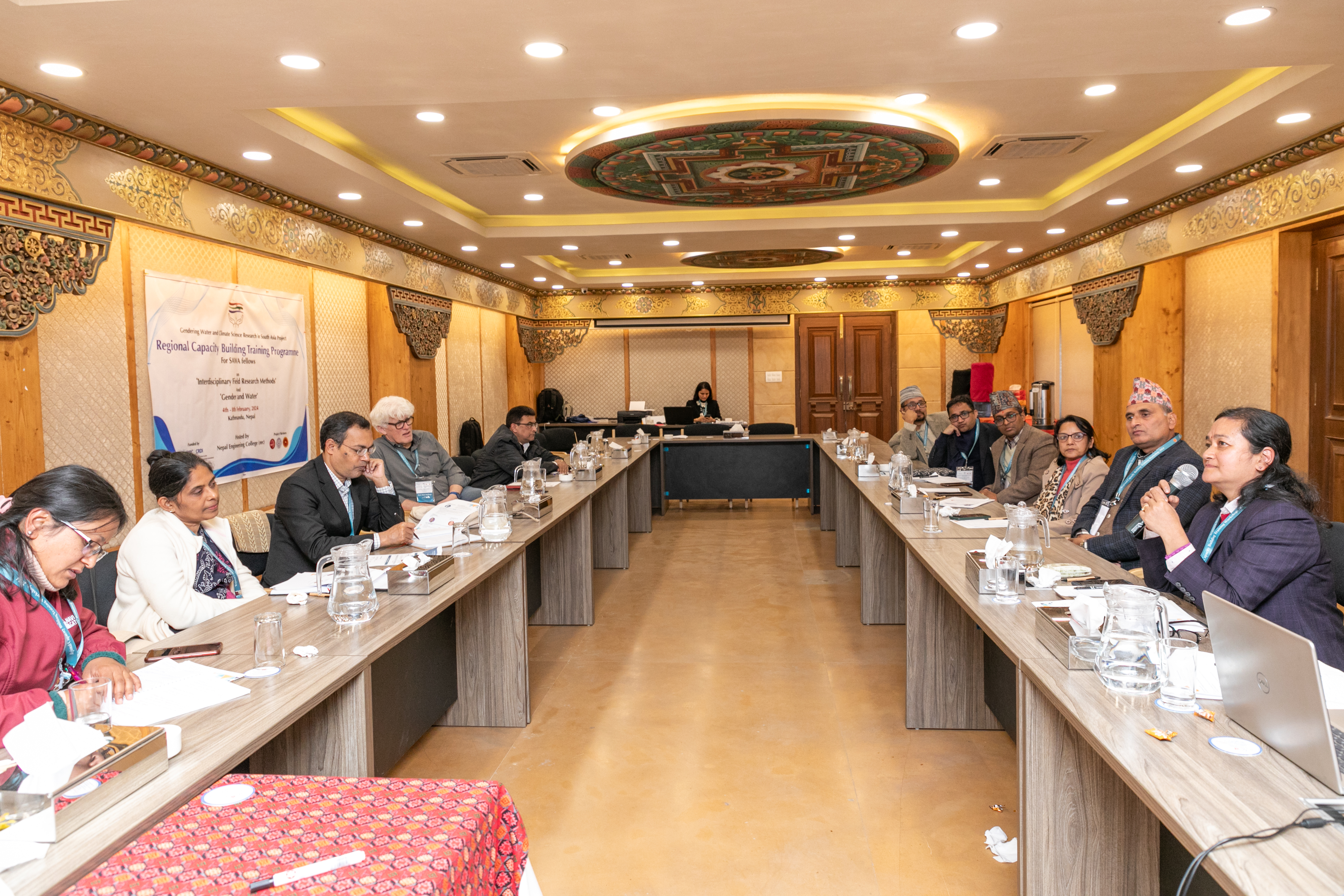
Regional Dissemination and Learning workshop, 03-05 Feb 2026, Kathmandu, Nepal
The village resource map prepared by a former student of a school for research work and resource mapping learnt during the training programme
A Panel discussion with Policy Shapers in Kathmandu: towards Understanding the gap in gendering Water and Climate Science and engineering education, research and professional realm

The South Asia Water (SAWA) Program

A pioneering fellowship initiative designed to develop capacity among young scholars across South Asia.

Since its inception in 2005, the program has aimed to establish long-term partnerships in water science and technology while addressing the region's critical water and climate challenges. Developed by a South Asia-based consortium of four engineering institutes and a water policy research institute, SAWA focuses on interdisciplinary education, innovation-driven research, and gender-inclusive approaches to water resource management.
Primary Goals

Training Professionals

Train a critical mass of South Asian water professionals in interdisciplinary approaches to integrated and gender-sensitive water resources management, while fostering a more balanced gender representation within the field.

Innovation-Driven Research

Conduct research focused on social learning and innovation in real-world settings, involving water resource users and other stakeholders as key participants in capacity-building efforts.

Knowledge Building

Build a knowledge base on Integrated Water Resources Management (IWRM), gender, and water issues while fostering collaboration across South Asia through networking, publications, and events such as workshops and conferences.

Evolution of the Program

2006-2010

Phase 1: Crossing Boundaries

Initial phase focusing on establishing cross-border partnerships and foundational research in water science.

2012-2015

Phase 2: SAWA Fellowship

Development of the fellowship program to train young scholars in interdisciplinary water resources management.

2017-2021

Phase 3: SAWA Leadership

Expansion of leadership development and capacity building initiatives across South Asia.

2022-2026

Phase 4: Gendering Water and Climate Science Research

Current phase integrating gender perspectives into water and climate science research across South Asia.

Program Components

01
Masters (M.E./M.Tech) and Ph.D. Programs in IWRM

Providing advanced education and training in IWRM, with hands-on experiences to apply theoretical knowledge in real-world settings.

02
Capacity Building for Faculty Members

Offering resources such as case studies, reference materials, mentoring, and network creation to enhance faculty capabilities.

03
SAWA (South Asia Water) Fellowship

Supporting students, particularly women, in pursuing higher education in water management and climate change sciences.

Objectives

South Asia, home to some of the world's most sensitive socio-ecological systems such as eco-sensitive island nations, the Himalayan region, and low-lying deltaic areas is highly vulnerable to the impacts of climate change and water insecurity. This makes research on water and climate science (WCS) both necessary and highly relevant. While social and gendered research in WCS is critical, it remains largely underdeveloped. Social and gender theories, often rooted in the social sciences and humanities, struggle to bridge the disciplinary divide with the natural sciences. Additionally, there is limited understanding of how pedagogy, institutional structures, and market forces influence or inhibit interdisciplinary and gender-focused research and practices. Building on previous efforts, the current action research project aims to strengthen the integration of gender analysis into water and climate science and technology (S&T) research and practices by promoting gender-responsive pedagogical approaches in higher education institutions across three South Asian countries: Sri Lanka, Nepal, and Bangladesh.

Specific Objectives
01
Understand barriers and catalysts

Understand barriers and catalysts for effective practice of interdisciplinarity and gender analysis in WCS research, with particular focus on whether gender inclusivity among WCS scholars improves this practice.

02
Improve frameworks and tools

Improve frameworks of methods, approaches, and pedagogical tools to effectively translate social and gender theory and analyses across disciplinary boundaries between social and natural sciences, and embody these frameworks in a common teaching curriculum and capacity building of 35 fellows towards their postgraduate research.

03
Strengthen networks and platforms

Strengthen a network and platform of multiple stakeholders for knowledge exchange, advocacy, and mentorship of young water and climate scientists for fostering and developing interdisciplinary research within and beyond higher education and academia.

Scroll